Looking is not observing: what the city hides in plain sight
Looking is not observing: what the city hides in plain sight
The difference between passing through a place and understanding it completely changes the urban experience
Looking at a city does not always mean understanding it. Most people pass through the same neighborhoods, the same squares, and the same streets every day without paying much attention to them. The journey becomes automatic, the gaze becomes accustomed, and the urban environment begins to function as a constant, almost invisible backdrop. The city is there, but it is not processed.
This phenomenon is not a response to disinterest, but rather a natural mechanism of adaptation. In environments saturated with stimuli, the brain learns to filter out what it does not consider a priority in order to move forward. Shop windows, facades, symbols, and architectural details are relegated to the background in the face of the urgency of reaching one's destination. The result is an efficient but superficial urban experience.
However, a small change in attitude is enough for that same environment to begin to reveal another layer. When movement ceases to be purely functional and a minimal intention to observe appears, perception changes. It is not a question of knowing more facts or receiving explanations, but of paying attention in a different way. Looking and observing are not equivalent actions.
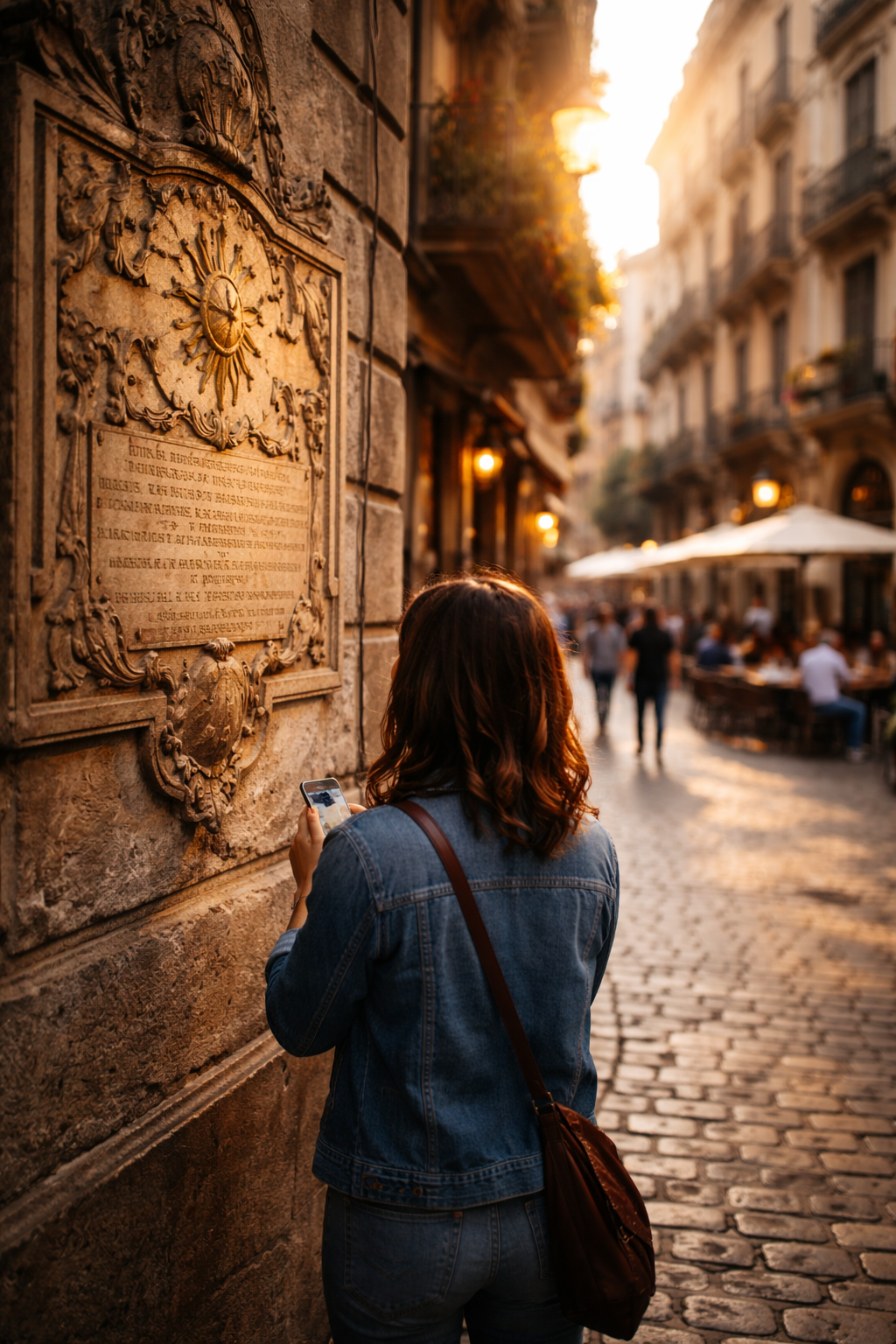
While looking involves passively receiving information, observing requires participation. It involves stopping to look, discerning what is relevant, connecting elements, and asking questions, even if they are unconscious. In this process, details that previously went unnoticed take on meaning: an inscription eroded by time, an unusual orientation of a building, a symbol repeated in different parts of the neighborhood.
Many of the most interesting urban stories are not hidden, but ignored. They do not need to be unearthed, but read. The difference between those who perceive them and those who do not usually lies in the attitude with which they walk through the city. When a person walks with a minimum of curiosity—without a fixed script, without their attention completely directed by a screen—the environment begins to reorganize itself. The secondary stands out. The everyday becomes strange. The feeling arises that the city is responding.
This change has clear consequences on the experience. The pace slows down, attention intensifies, and the journey ceases to be a simple route between two points. The city stops acting as a backdrop and becomes an active space, open to interpretation. It is not that the environment has changed, but rather that the way of relating to it is different.
Those who develop this form of observation often describe a lasting effect. After experiencing the city in a way that focuses on attention and discovery, it becomes difficult to revisit the same places in the same way. Your gaze is re-educated. Details reclaim their space. Even the familiar city begins to raise questions where before there was only routine.
This transformation does not require great effort or specialized knowledge. It does not consist of analyzing every element or turning every walk into an exhaustive investigation. It is enough to recover a more conscious relationship with the environment, in which the walker ceases to be a mere user of space and becomes an active part of it.
In an increasingly fast-paced urban context guided by optimized routes, observation may seem like an unnecessary luxury. In reality, it is what allows the experience to leave its mark. Because while looking is enough to find your way around, observing is what makes a city memorable. And it is in this almost imperceptible but decisive difference that the urban environment begins to reveal everything that is normally hidden from plain sight.